
English| EUR
Suggested for you
More currencies
Choose a language
At roughly 78 degrees north, the calendar in Longyearbyen is written by light and wind rather than by the thermometer alone. This Longyearbyen weather by month guide sets out what each part of the year actually looks like at sea level, from the dark season to the weeks when the sun never sets. It is written for travellers planning fjord excursions from the town's small harbour.
Quick answer
Longyearbyen weather by month splits into two extremes: polar night from late October to mid-February, and midnight sun from late April to late August. The town itself is open around the clock, 00:00–23:59, with free entry, so conditions rather than access dictate plans. Wind and sea ice, not the thermometer alone, decide whether a boat sails.
Longyearbyen sits at roughly 78 degrees north, yet it is not the coldest settlement on its latitude. A northern arm of the North Atlantic Drift, the West Spitsbergen Current, carries comparatively mild water along the west coast of Spitsbergen. That current keeps parts of Isfjorden workable when the map suggests otherwise, and it is the single fact that explains most of what a longyearbyen weather by month chart shows. Without it, the fjord outside town would behave like the frozen coasts of northern Greenland. For visitors, the variable that reorganises a trip is light rather than temperature. The sun stays below the horizon through the dark months, returns as a long blue twilight, then refuses to set at all across the high summer weeks. Været i Longyearbyen also turns on wind: katabatic air draining down Adventdalen can strip several degrees off the felt temperature, and wind chill on open water in Adventfjorden is always harsher than the reading at Svalbard Airport. Precipitation, by contrast, is modest. This is an Arctic desert built on permafrost, where snow is redistributed by wind more often than it is newly fallen. Cloud, fog and sea state matter more to a day's plan than millimetres of rainfall. Sea ice does the rest of the work. Drift ice and fast ice in the inner fjords decide which stretches of coast a vessel can reach in a given month, which is why the Svalbard climate month by month is read closely by boat operators before it is read by travellers. Settlements such as Barentsburg and Pyramiden, and glacier fronts including Nordenskiöldbreen and Esmarkbreen, move in and out of range with the ice edge. A calm week in one month can open water that a gale in another closes. The practical use of a longyearbyen weather by month overview is therefore comparative, not predictive. It shows the shape of a typical month; it cannot promise a particular day. Travellers who match an intended activity to the conditions that support it — sailing, hiking on thawed ground, or travelling over frozen valleys — lose far less to cancellation than those who fix a date first and hope. Forecasts should be checked close to departure, and any fjord excursion confirmed against the operator's own sailing window rather than a long-range average.
“Longyearbyen is not the coldest place on its latitude, and a single ocean current is the reason.”
The best time to visit Longyearbyen depends on whether you seek the Midnight Sun or the Polar Night. Late spring and summer, from May to August, offer constant daylight and milder temperatures for outdoor activities.
Cold, -10°C to -20°C; total darkness.
Cold, -10°C to -15°C; increasing light.
Cool, 0°C to 8°C; constant sunlight.
Verdict: The period from June to August is optimal for boat tours and exploring the landscape under the constant light of the Midnight Sun.
Longyearbyen sits at 78°N, so what you pack matters more than when you arrive — build a kit that handles wind, wet, and sub-zero air.
The climate in Longyearbyen is defined by its extreme northern latitude, resulting in significant shifts in light and temperature throughout the year. These environmental conditions shape both the local infrastructure and the natural landscape of Svalbard.
The highest temperature ever recorded in Longyearbyen occurred in July 2020, when the mercury reached 14.8 degrees Celsius. This remains a notable deviation from the typical summer averages of 5 to 7 degrees Celsius.
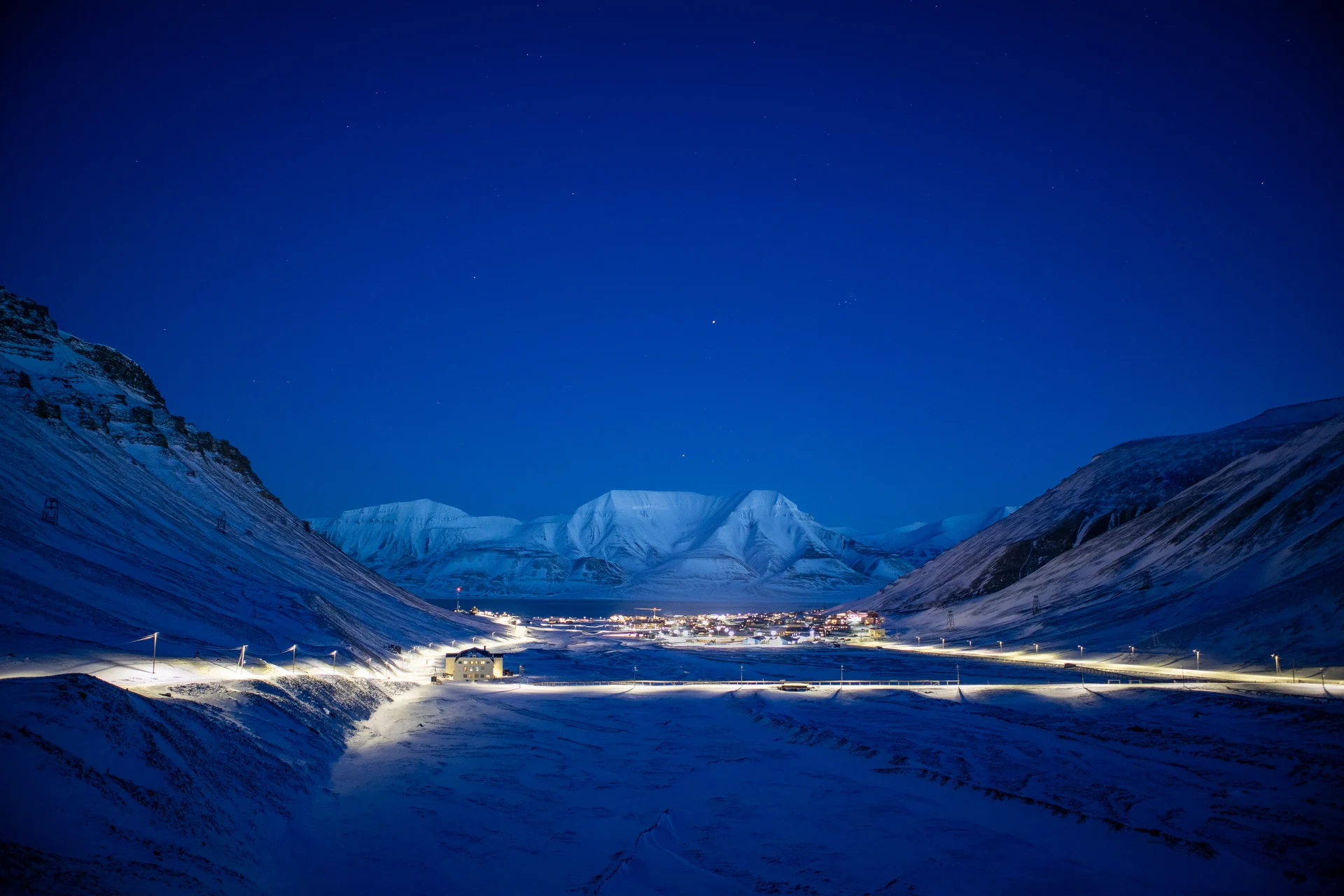
Longyearbyen experiences the Polar Night from late October to mid-February, during which the sun remains below the horizon. Conversely, the Midnight Sun occurs from late April to late August, providing 24 hours of daylight.
Much of the ground in Longyearbyen is comprised of permafrost, which requires buildings to be constructed on steel piles to prevent structural instability from thawing soil. This engineering practice is essential for maintaining the integrity of local infrastructure.
Despite the presence of glaciers, Svalbard is classified as an Arctic desert. The region receives very low annual precipitation, often less than 200 millimeters, with much of it falling as snow.
Winter temperatures typically range between -10 and -20 degrees Celsius, though they can drop significantly lower depending on wind chill and weather patterns. These conditions necessitate careful planning for any outdoor excursions.
As a public town, Longyearbyen remains accessible to visitors throughout the entire week. There are no gates or restricted entry times for the town area itself.
Longyearbyen is a public town, not a gated attraction. There are no entrance fees required for access to the settlement itself.
Verdict: Visitors pay 0 NOK for access to the town, as it is a public municipality rather than a ticketed attraction.
Everything you need to know about longyearbyen weather by month
To understand the climate, look at seasonal averages since temperatures shift drastically between the dark winter and the midnight sun period. Examining longyearbyen weather by month helps you prepare for the high Arctic environment found at this latitude.
Yes, sea ice conditions and visibility linked to monthly weather patterns dictate boat tour availability. Operators adjust schedules based on the safety requirements of the surrounding fjords.
You should pack windproof and waterproof layers regardless of when you visit, as conditions change rapidly in the Arctic. Sturdy footwear and thermal base layers are essential components for any excursion in this terrain.
There is no entrance fee to enter the town, as it is a public municipality rather than a private attraction. You are free to explore the town and surrounding areas at your convenience.
During the polar night, temperatures can be extreme, and the lack of sunlight presents unique challenges for outdoor activities. Researching longyearbyen weather by month allows you to plan appropriately for limited daylight hours.
The summer months of June through August are typically best for boat tours when the fjords are open and the midnight sun provides constant light. This period allows for easier navigation to glaciers and historic sites.
Forecasts in Svalbard change frequently due to the shifting Arctic winds, so treat them as a short-term guide rather than a long-term guarantee. Always check local sources for the most accurate information before departing.
Longyearbyen is open to visitors 24 hours a day, meaning you can arrive at any time. Weather conditions significantly impact travel, so monitor forecasts closely regardless of your chosen arrival window.
Svalbard Boat Tours
Read more GuideHow to Get to Longyearbyen
Read more GuideLongyearbyen Rules and Safety
Read more GuideCruise Ship Schedule
Read more Tickets & toursPyramiden & Glacier Boat Tour
Read more Tickets & toursBarentsburg Boat Trip
Read more Tickets & toursWinter Boat Trips
Read more